Hype v. Reality: How to Find AI That Actually Matters
No, I don’t work for a private equity firm, a VC, or some other investment group, but I’m no fool—and if you use a bit of critical thinking and do some research, you can spot the trends too. With AI, the promise and potential feel limitless, but so does the hype. As an investor, you’re caught in a whirlwind of AI startups, each one claiming to be more “transformative” than the last. But here’s the question: how do you cut through the noise to spot the AI technologies that genuinely solve problems versus those that just look flashy on a pitch deck? Welcome to your playbook on avoiding “WTF tech” and finding AI investments that matter.
TL;DR
Why It Matters: In a market flooded with AI hype, investors need a clear lens to discern truly valuable applications from the rest. AI that addresses real problems, like climate adaptation, healthcare access, and sustainable agriculture, is worth funding, while superficial “WTF tech” often fails to deliver long-term value. (Have you noticed a theme in my articles? Value means a ton to me.)
The Data:
Hype risk: 40% of AI startups focus on applications that lack clear, measurable ROI (McKinsey).
Consumer trust: 56% of consumers prefer companies that use AI ethically and transparently, especially in healthcare and finance (Deloitte).
Sustainability demand: 78% of investors consider environmental impact important when evaluating new tech investments (BCG).
Key Examples:
ClimateAI: Delivers AI-driven climate models, helping businesses mitigate climate risks.
PathAI: Uses AI for pathology diagnostics, improving healthcare in underserved areas.
Juicero: AI-driven juicer that failed to add real value, illustrating tech hype without practical purpose.
Melissa’s Insight: “AI is powerful, but only when used with purpose. Too many investments go to flashy ideas with no substance. AI that truly addresses core challenges, that’s the AI worth backing.”
The Takeaway/Action: Investors should focus on AI with clear, measurable impact. By avoiding gimmicky applications and supporting real-world solutions, we can drive lasting value that transcends the AI trend cycle.
Hype vs. Reality: Why “AI-Powered” Isn’t Always Better
Everywhere you look, it seems there’s another AI-driven app promising to revolutionize the world. But as with every tech boom (remember the dot-com bubble?), a lot of these solutions don’t necessarily make life better. Many are gimmicks dressed up in high-tech lingo, giving investors the illusion of innovation without delivering real value.
The goal here isn’t to dismiss all AI but to make sure we’re placing our bets on tech that’s solving real problems and has the potential to endure. Here’s a breakdown of what to look for, and what to avoid.
Red Flags: How to Spot “WTF Tech” in AI
Not all AI is created equal. Some applications truly innovate, while others seem designed to jump on the AI bandwagon. Here’s a checklist of red flags to help you spot the difference:
Vague Problem Statements: If the pitch sounds like it’s promising the world without pinpointing a clear, real-world problem, tread carefully. Good AI solves specific, tangible issues.
Overemphasis on Buzzwords: Look out for terms like “disruptive,” “revolutionary,” or “game-changing” without a clear explanation of what makes the technology truly unique.
Lack of Evidence or Metrics: If a company can’t show a working prototype, case studies, or measurable results, it’s likely selling an idea rather than a product.
Questionable ROI: Ask yourself if this AI will actually make or save money in the long term. If the value proposition isn’t clear, it’s likely more hype than substance.
Questions Investors Should Ask Before Jumping In
For a more nuanced approach, here are some key questions to consider:
Does This Tech Solve a Real Problem?
Does it address an actual need, or is it a solution in search of a problem? Look for AI applications in industries with well-defined pain points, like healthcare, climate tech, and logistics, where AI can make measurable improvements.
How Does It Compare to Competitors?
A good AI company will know its competition and articulate why their technology is different. Avoid startups that can’t explain their edge or have no apparent reason for their AI choice other than novelty.
Is There a Path to Scale and Sustainability?
AI tech often requires substantial data and processing power. Companies with scalable models are more likely to offer long-term value. Ask if they have the infrastructure to grow their model sustainably.
What Ethical Safeguards Are in Place?
AI ethics isn’t just a trend; it’s critical to sustaining trust. Ensure the company has clear policies on data privacy, bias mitigation, and transparency. AI without ethical considerations can quickly turn into a liability.
Case Studies: AI That Matters vs. AI That’s “WTF”
To put this into perspective, let’s look at a few examples that highlight AI worth your attention versus those that raise eyebrows.
AI That Matters: Real-World Applications
ClimateAI: Instead of just riding the AI hype, ClimateAI targets a real and pressing issue…climate resilience. Their AI models help predict and mitigate climate risks in agriculture and supply chains, making it a true value-adding solution.
Babylon Health: This company’s telemedicine platform brings affordable, accessible healthcare to underserved communities. Babylon Health uses AI where it counts, addressing the real healthcare access gap.
Blue River Technology (John Deere): In agriculture, Blue River’s See & Spray technology uses AI for precision farming, reducing pesticide use and improving crop yields. This is AI at its best—innovative and impactful.
AI That’s “WTF”: Overhyped and Questionable Value
Juicero: This infamous “AI-powered” juicer squeezed proprietary juice packs—until people discovered they could get the same result by squeezing the packs by hand. Juicero exemplifies tech without a purpose.
Emotion Recognition in Hiring: Some companies are investing in AI that “reads” candidates’ emotions during interviews. Not only is this technology highly subjective and prone to error, but it also raises ethical questions and lacks scientific backing.
AI-Powered Toothbrushes: Some AI-powered toothbrushes track brushing habits, analyze brushing patterns, and provide “personalized” feedback on how to improve oral hygiene. While this may sound innovative, many users find the benefits minimal compared to the added expense. Traditional toothbrushes, or even electric ones without AI, often do the job just as well for a fraction of the cost. The AI-powered toothbrush can feel like a high-tech addition looking for a problem to solve, with murky ROI for consumers who don’t necessarily need data-driven brushing.
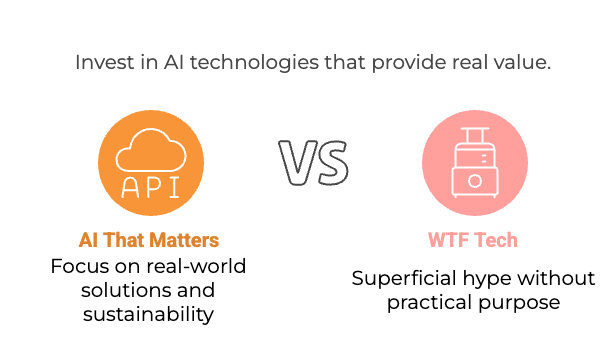
The Case for Balanced AI Investment: Financial and Social ROI
Investing in AI that matters doesn’t mean sacrificing financial returns. In many cases, AI that addresses real issues, like climate risk, healthcare access, and sustainable agriculture, has both financial and social ROI. These are the kinds of projects that are likely to endure, offering stability and meaningful impact rather than just a temporary hype cycle.
Conclusion: Choose Impact Over Hype
As AI continues to expand into every industry, the challenge for investors is clear: discern the difference between meaningful tech and “WTF tech.” By asking the right questions, watching for red flags, and focusing on companies solving real problems, you can align your investments with projects that offer both impact and profitability.
In a market filled with “AI-powered” everything, the choice to invest wisely has never been more important. Let’s make sure we’re backing the kind of AI that leaves a lasting legacy, not just another tech fad.
So the next time you see an “AI-driven” pitch, remember: it’s about impact, not just impressive jargon. Choose wisely.
Sources
McKinsey & Company. (2022). State of AI in Business 2022.
Provides data on the percentage of AI startups with questionable ROI and discusses the “AI hype cycle” risks.
Deloitte Insights. (2023). The Consumer's Perspective on AI.
Covers consumer expectations around ethical and transparent use of AI in industries like healthcare and finance.
Boston Consulting Group (BCG). (2022). Sustainability in Investment Decisions.
Examines investor attitudes toward sustainability, particularly when evaluating technology investments.
The Verge. (2024). Juicero and the risks of hype-driven AI.
Analysis of the Juicero failure, offering insights into how hype-driven tech can lead to impractical products.
PathAI. (2023). Pathology for underserved regions: AI at the frontier.
Discusses PathAI’s efforts to bring AI-powered diagnostics to low-resource areas and the healthcare impact of its technology.
MIT Technology Review. (2022). Why some AI investments fail: Lessons from the dot-com bubble.
Provides an in-depth look at how investor enthusiasm can lead to over-investment in tech with limited practical application.